
Before you begin
- Multi-region topology patterns are almost always table-specific. If you haven’t already, review the full range of patterns to ensure you choose the right one for each of your tables.
- Review how data is replicated and distributed across a cluster, and how this affects performance. It is especially important to understand the concept of the “leaseholder”. For a summary, see Reads and Writes in CockroachDB. For a deeper dive, see the CockroachDB Architecture Overview.
- Review the concept of locality, which CockroachDB uses to place and balance data based on how you define replication controls.
- Review the recommendations and requirements in our Production Checklist.
- This topology doesn’t account for hardware specifications, so be sure to follow our hardware recommendations and perform a POC to size hardware for your use case. For optimal cluster performance, Cockroach Labs recommends that all nodes use the same hardware and operating system.
- Adopt relevant SQL Best Practices to ensure optimal performance.
Configuration
-
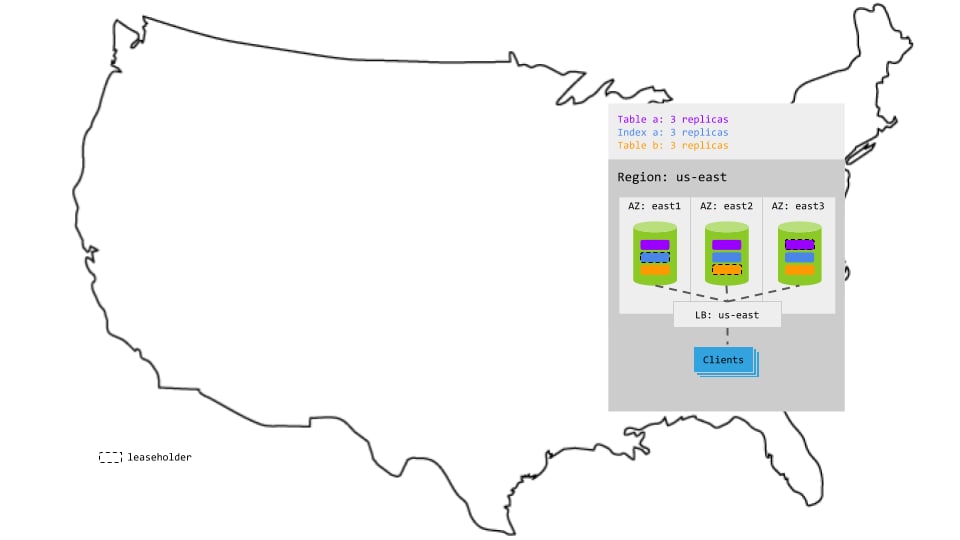
Provision hardware as follows:
- 1 region with 3 AZs
- 3+ VMs evenly distributed across AZs; add more VMs to increase throughput
- App and load balancer in same region as VMs for CockroachDB
- The load balancer redirects to CockroachDB nodes in the region
-
Start each node on a separate VM, setting the
--localityflag to the node’s region and AZ combination. For example, the following command starts a node in the east1 availability zone of the us-east region:
--locality set as described, CockroachDB balances each range of table data across AZs, one replica per AZ. System data is replicated 5 times by default and also balanced across AZs, thus increasing the resiliency of the cluster as a whole.
Characteristics
Latency
Reads
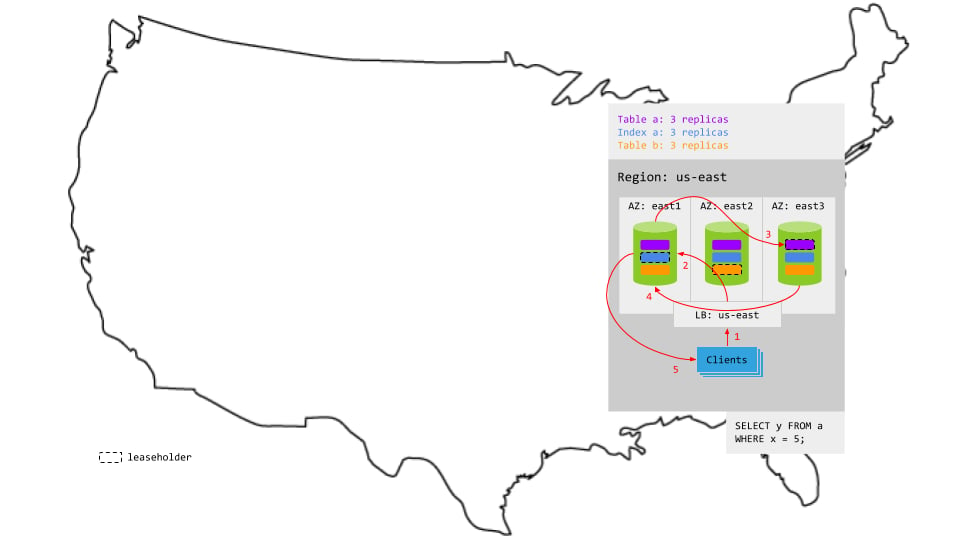
Since all ranges, including leaseholder replicas, are in a single region, read latency is very low. For example, in the animation below:- The read request reaches the load balancer.
- The load balancer routes the request to a gateway node.
- The gateway node routes the request to the relevant leaseholder.
- The leaseholder retrieves the results and returns to the gateway node.
- The gateway node returns the results to the client.
Writes
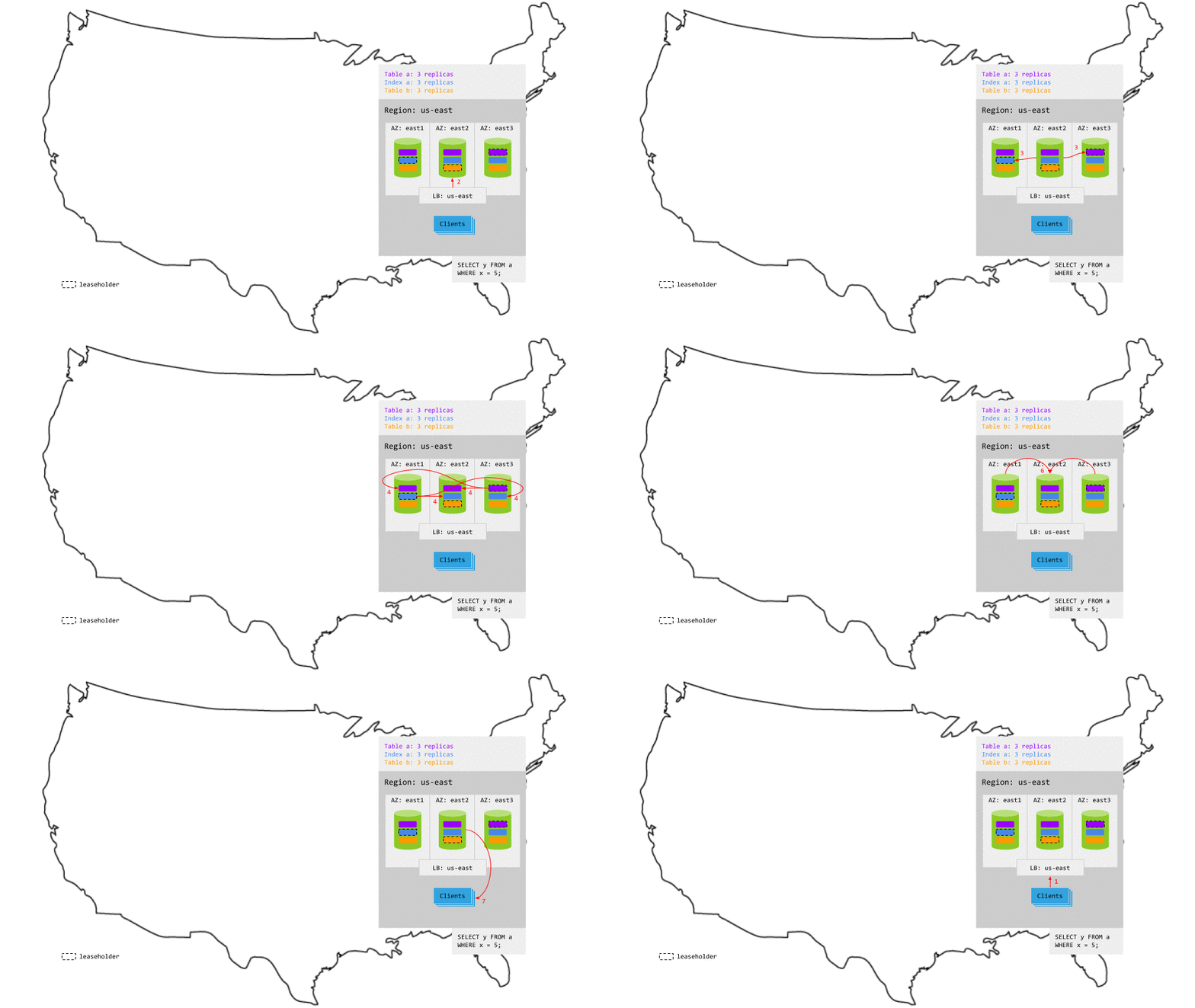
Since all ranges are in a single region, writes achieve consensus without leaving the region and, thus, write latency is very low as well. For example, in the animation below:- The write request reaches the load balancer.
- The load balancer routes the request to a gateway node.
- The gateway node routes the request to the leaseholder replicas for the relevant table and secondary index.
- While each leaseholder appends the write to its Raft log, it notifies its follower replicas.
- In each case, as soon as one follower has appended the write to its Raft log (and thus a majority of replicas agree based on identical Raft logs), it notifies the leaseholder and the write is committed on the agreeing replicas.
- The leaseholders then return acknowledgement of the commit to the gateway node.
- The gateway node returns the acknowledgement to the client.
Resiliency
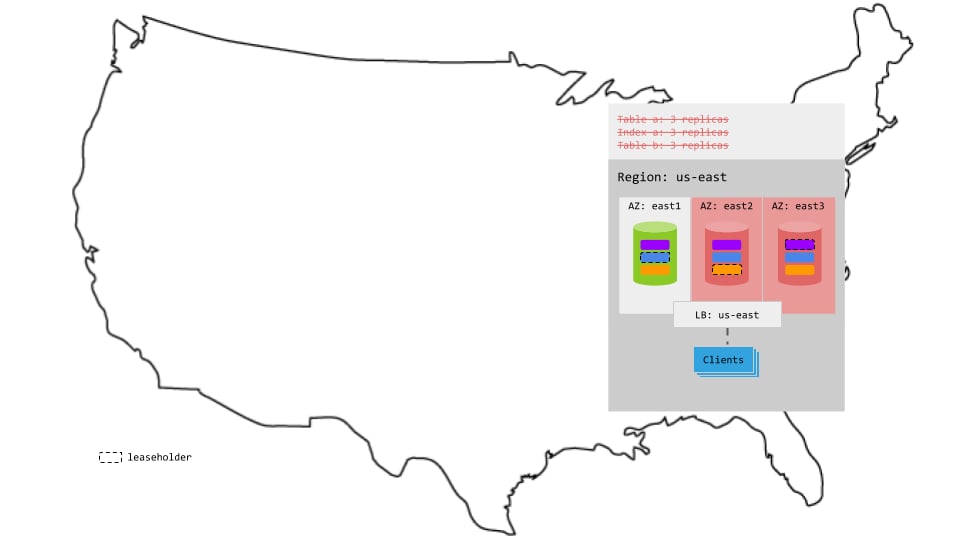
Because each range is balanced across AZs, one AZ can fail without interrupting access to any data: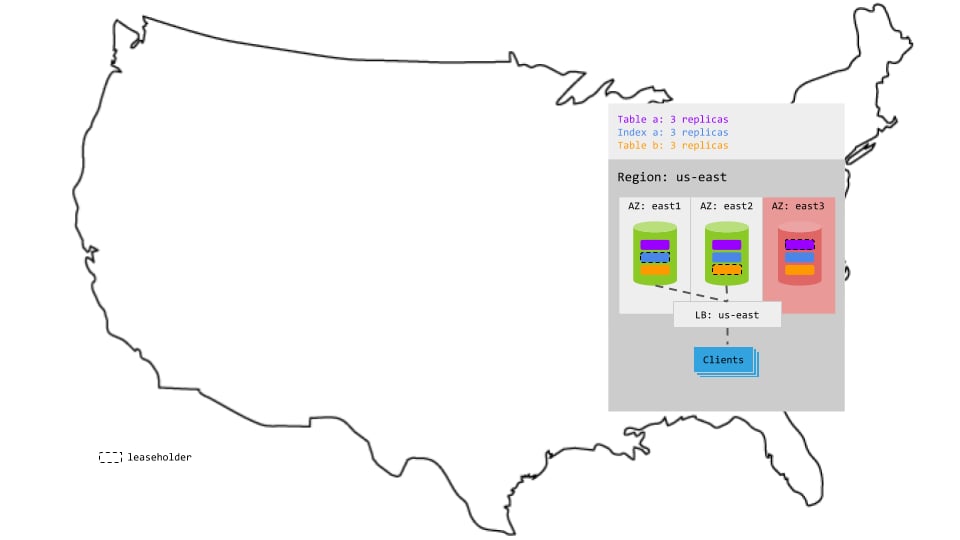
See also
- Multi-Region Capabilities Overview
- How to Choose a Multi-Region Configuration
- When to Use
ZONEvs.REGIONSurvival Goals - When to Use
REGIONALvs.GLOBALTables - Low Latency Reads and Writes in a Multi-Region Cluster
- Migrate to Multi-Region SQL
- Secondary regions
ALTER DATABASE ... SET SECONDARY REGIONALTER DATABASE ... DROP SECONDARY REGION- Topology Patterns Overview
- Single-region patterns
- Multi-region patterns